

In many technical service organizations, the operational reality in scheduling differs greatly from the strategic goals set by senior management. While senior management discusses future-proof service models, everyday work is characterized by a paper-based system, incomplete forms, and manual data transfers. A successful digital transformation therefore requires breaking down the silos that have developed between back-office staff, scheduling, and service technicians in favor of a centralized database.
In this article, you’ll learn how to distinguish these incremental adjustments from a comprehensive structural transformation in technical customer service.
What Does Digital Transformation Mean?
Digital transformation refers to the profound transformation of business processes, organizational structures, and business models through the use of modern technologies. It goes far beyond the mere digitization of analog data and changes the way companies create value and generate customer benefits. In Field Service Management (FSM), this transformation means the gradual replacement of isolated process steps with end-to-end, data-driven workflows between back-office staff, dispatchers, and service technicians.
The Difference Between Digitization and Digital Transformation in the Service Industry
Many executives use the terms “digitization” and “digital transformation” interchangeably. The fundamental difference between digitization and digital transformation lies in the scope of the change. Digitization refers to converting analog data or work steps into a digital format. A paper form becomes a PDF on a tablet, while the process logic remains unchanged. Digital transformation, on the other hand, changes the actual value chain in technical customer service and connects previously separate processes.
| Digitalization | Digital Transformation | |
| Goal | Increase the efficiency of individual work processes | Realign service processes and business models |
| Focus | Digitally represent analog data and forms | Connect systems, data, and teams |
| Scope | Selective use within individual departments | Across departments |
| Time Horizon | Completed project with a limited scope | Ongoing strategic transformation process |
| Example | Service technician completes the report as a PDF | Service assignments are automatically transferred to ERP, billing, and spare parts planning |
Goals of Digital Transformation in the Company—Reducing Administrative Burdens and Shortening Response Times
Technical changes have a profound impact on day-to-day operations and require guidance from senior management. The goals of digital transformation in the company are based on the pain points in daily processes:
Digital Transformation in Service: Seamless Data Flows Instead of Isolated Paper Reports
Fault reports received by phone end up in Excel spreadsheets, dispatchers plan routes on paper, and service technicians fill out reports by hand. These manual processes delay feedback to the ERP system by days and result in long turnaround times and data entry errors. Sustainable structural change requires reevaluating individual work steps:
- Graphical Dispatching and Resource Planning: Innosoft’s dispatching software consolidates technician qualifications, spare parts inventory, and location data into a single interface, enabling routes to be planned without time-consuming follow-up inquiries.
- Spare Parts Management and Warehouse Logistics: Innosoft’s FSM system directly reconciles component requirements during order creation with inventory levels in the central warehouse and in the service vehicle.
- Mobile data collection: Service technicians document working hours, material usage, and customer signatures directly on their smartphone or tablet using the Innosoft app.
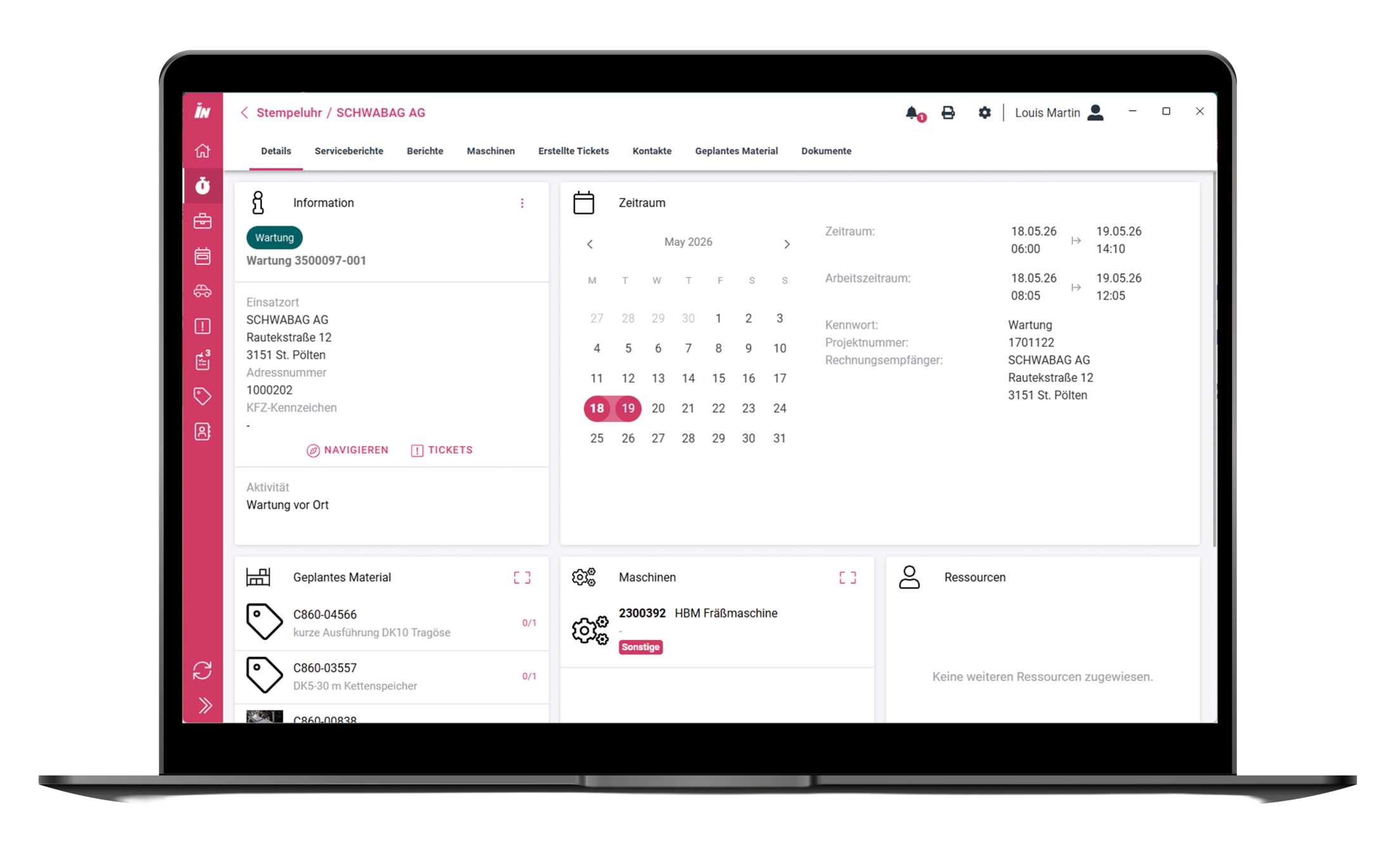
This highlights the gap between piecemeal digitization and true process adaptation. A fillable PDF on a tablet leaves the workflow in its isolated form. In a digital transformation of field service, mobile data entry via systems such as Innosoft triggers direct follow-up steps in the ERP system, ensuring that feedback reaches headquarters without delay.
Digitalization in Businesses—A Clear Gap Between Aspiration and Reality
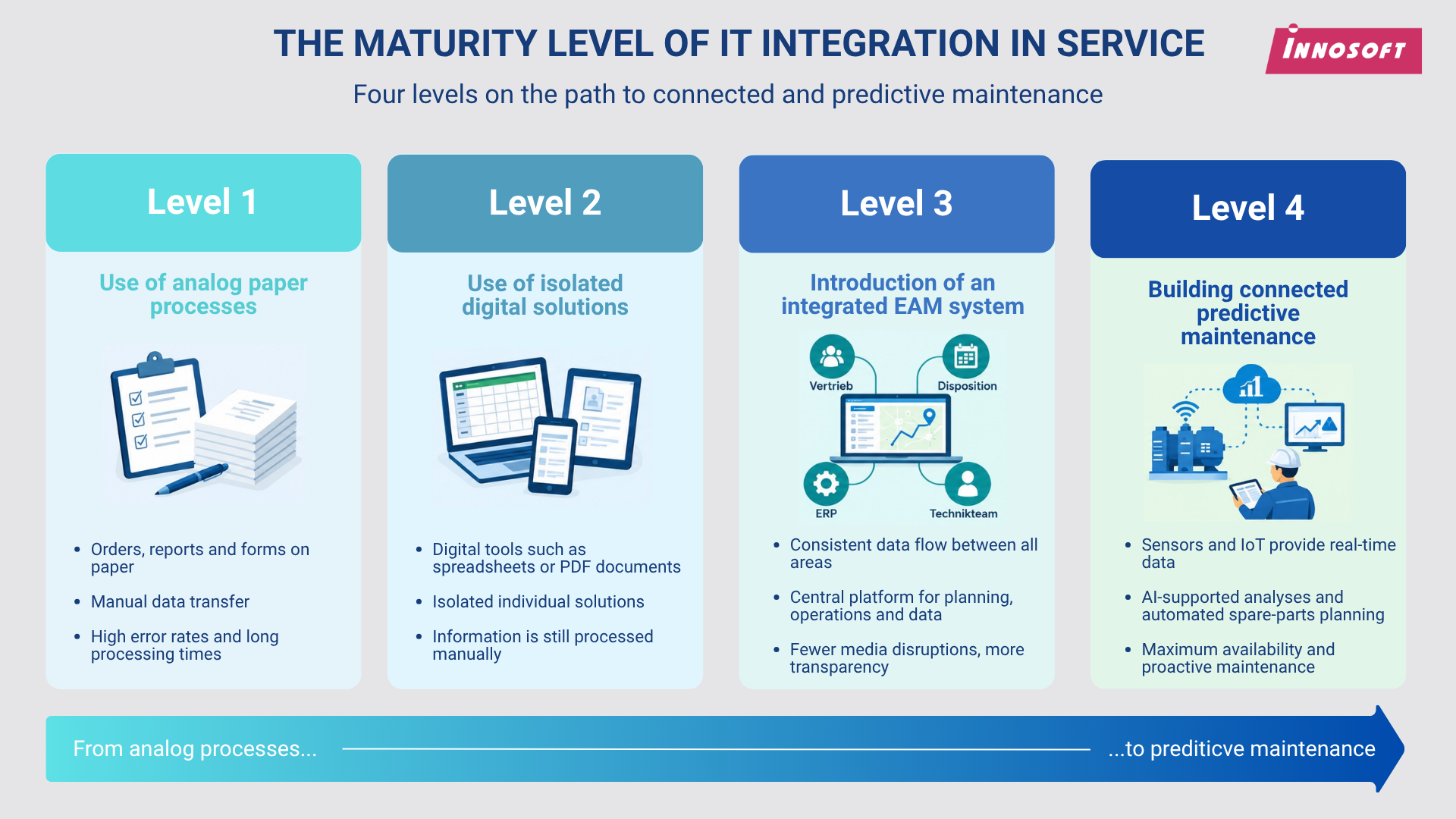
The Bitkom study on the digitalization of the economy paints a mixed picture. 72 percent of German companies operate without a central digital strategy. More than half report problems in managing the digital transformation. In technical customer service, this leads to differences in efficiency in day-to-day operations. Four levels can be distinguished based on the maturity of IT integration in service:
- Level 1: Use of analog paper-based processes
- Level 2: Use of isolated digital solutions
- Level 3: Introduction of integrated FSM systems
- Level 4: Development of networked, predictive maintenance
Many medium-sized companies remain stuck at the second level. Although staff members use spreadsheets or PDF documents, they continue to process information manually. The transition to networked FSM systems lays the foundation for data to flow seamlessly between administration and service technicians.
Seamless Workflows Through Digital Transformation in the Field
Paper-based processes slow down order completion in the field. Innosoft integrates scheduling with technicians’ workflows and bridges data gaps with the ERP system.
Digital Transformation Technologies – Cloud and Algorithms in FSM
Technological advances are transforming work processes in the customer service departments of machinery and plant manufacturers. Three core technologies form the foundation of modern FSM systems and drive daily service operations:
Only by integrating these approaches can isolated data structures be eliminated. The transitions between administration, scheduling, and field service become seamless, which shortens processing times and minimizes sources of error in data transmission.
Challenges in Implementing Digital Transformation in the Field
Software projects rarely fail due to a lack of technical understanding. Challenges usually arise during the course of the project when organizational factors slow down implementation. Without clear priorities from senior management, digital transformation in service risks getting bogged down in day-to-day operations. Another obstacle is employee resistance. Technicians and dispatchers reject new tools as soon as they perceive the software as a monitoring tool. Early training helps build the necessary acceptance. In addition, historically evolved IT structures complicate the exchange of information. If there are no direct interfaces to the ERP system, data gaps arise between the back office and the field service. FSM browser-based solutions such as Innosoft gradually integrate existing legacy systems and reduce this burden.
Digital Transformation in Customer Service – FSM Software as a Central Element
The transition from manual workflows to digital processes requires robust systems and a clear strategic direction. Isolated standalone solutions or manual corrections quickly reach their limits in day-to-day field service operations. The direct flow of information between headquarters and the technical facilities on-site forms the foundation for reducing turnaround times and increasing transparency. Specialized FSM software such as Innosoft connects resource planning at headquarters with mobile workflows in the field. Modular structures enable the phased integration of existing ERP systems to minimize implementation risks.
FAQ – Frequently Asked Questions About Digital Transformation
Processes can be accelerated, data transmission error rates reduced, and operational costs lowered. In technical service, the primary focus is on increasing the first-call resolution rate, ensuring quick response times to service calls, and maintaining transparent workflows between headquarters and the field service team.
Digitization refers to the purely technical conversion of analog data into digital formats, such as scanning paper reports or using fillable PDFs. Digital transformation, on the other hand, describes the fundamental adaptation of entire business processes and work methods through the skillful use of networked technologies.
The transformation typically takes place in five sequential steps:
- Analysis: Assess the current state and identify inefficiencies in existing processes.
- Strategy Definition: Define the target state and select appropriate technologies.
- Piloting: Test digital tools in individual teams or subdivisions.
- Rollout: Implement successful systems company-wide and integrate them with existing IT infrastructures.
- Optimization: Continuously adapt and refine implemented processes based on real service data.
A classic example in plant engineering is the replacement of handwritten work reports with a mobile app for service technicians. The recorded work hours and material usage are fed directly back into the ERP system.
The first step is to identify current pain points in day-to-day service operations. The next step is to select modular FSM software that can be integrated into existing IT environments in phases. Involving dispatchers and technicians early on ensures acceptance of the new tools.