

In technical service, it quickly becomes apparent that digitalisation in field service does not begin with the system, but rather with existing processes. Only by looking at operational organisation and planning, cooperation between internal service staff and technicians, and existing structures can we see where digital support actually comes into play. Field Service Management (FSM) provides the technical framework within which processes can be clearly mapped and gradually developed.
This blog article shows you the role that digitalisation plays in field service in FSM and why a process-oriented approach is the basis for robust service processes and structured deployment planning.
Digitalisation in field service – what sets technical service apart
Technical service focuses on on-site customer service. Servicing, repairs, and commissioning are carried out under time pressure, often with clear response requirements. Digitalisation in field service affects precisely this area of work and focuses on its organisational integration.
Changing locations, different plant structures, and variable requirements are typical for technical field service. Service technicians work independently, but coordinate with dispatch and service management. In addition to their technical work, their job profile also includes providing feedback on the progress of the assignment.
Service technicians in action – tasks in technical field service
Everyday work in technical field service is characterised by operational assignments under real conditions. In addition to technical expertise, structured processes and comprehensible feedback are required. The specific field of activity can be structured along recurring assignment situations. Typical tasks of a service technician include:
- Performing maintenance and repair work on machines and systems
- Analyzing and troubleshooting technical malfunctions in compliance with specified response times
- Commissioning and functional testing, including documentation of results
- Recording working hours and material consumption for downstream processes
- Digital feedback on order status to dispatch and service management
- Documentation of anomalies and follow-up requirements for further planning
Service organisations under pressure – why digitalisation is becoming increasingly important in field service
Service organisations are under increasing pressure to adapt. Technical complexity, economic constraints, and rising customer expectations are simultaneously affecting processes, resource planning, and structures. The following aspects illustrate why digitalisation is becoming increasingly important in field service management:
- Increasing plant and service complexity: Networked systems, different maintenance cycles, and specific customer requirements call for structured information provision and traceable deployment processes.
- Contractually agreed performance indicators and SLAs: Response times, first-time resolution rates, and availability must be documented in a measurable way and stored in a form that can be evaluated.
- Shortage of skilled workers in technical service: Limited human resources make transparent capacity planning and realistic utilisation control necessary.
- Lack of transparency in analog processes: Paper-based feedback or isolated systems make it difficult to overview, track, and evaluate status.
- High administrative effort: Duplicate data entry and manual transfers take up time that is then lacking in operational use.
- Increased customer expectations: Reliable appointments, traceable documentation, and quick feedback are a given.
Digitalisation in field service addresses these challenges by consistently mapping service processes and providing a reliable data basis for planning and control.
Efficiently manage technical service with Innosoft
Use Innosoft’s process-oriented FSM software for resource planning, mobile feedback, and controlling. Request your personal consultation now.
Digitalisation in field service: Requirements for digital service processes
The starting point for any digitalisation initiative in service is a structured analysis of existing processes. Transparency regarding resource planning, feedback and responsibilities forms the basis for stable process mapping.
A clean database is equally important. Digital service processes require uniform order structures, well-maintained master data and consistent status definitions. Unclear data models lead to deviations in planning and evaluation.
In addition, organisational framework conditions must be taken into account. A coordinated understanding of roles, information flows and interfaces between scheduling, service management and field service is a prerequisite for robust processes. In addition, the existing system landscape with its integration options influences whether processes can be managed digitally throughout.
Field Service Management – The foundation of digitalisation in field service
Structured service processes require a stable regulatory framework. FSM forms the systematic basis for resource planning, execution and feedback of assignments, thereby creating the conditions for robust digitalisation in field service.
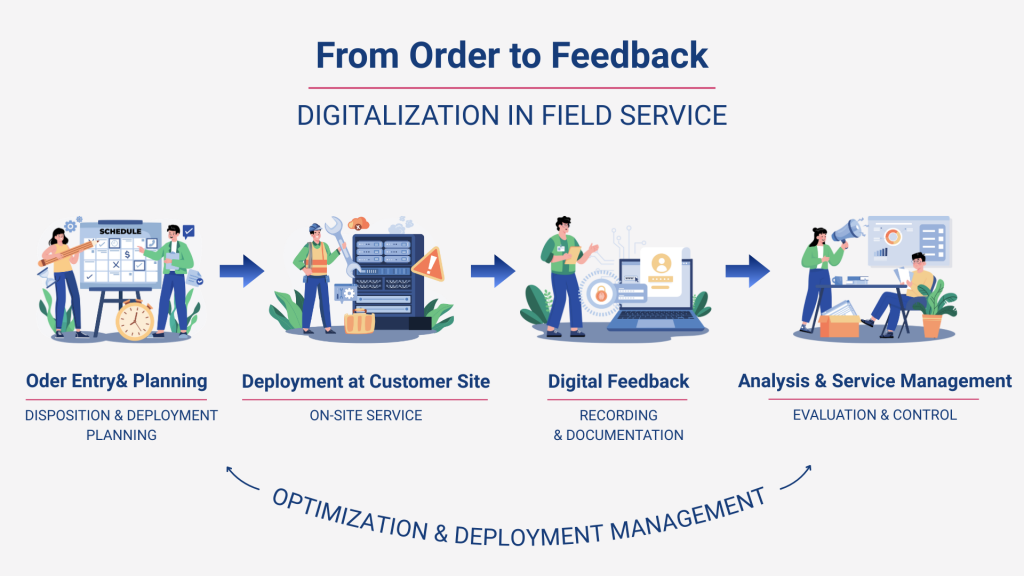
The focus is on end-to-end processes from order entry to service documentation. Dispatching, technical field service and service management work on a common data structure, which means that status information and resource utilisation remain traceable. At the same time, this framework enables the collection of relevant service metrics such as response time or productivity. Only when processes are managed consistently can operational performance be transparently evaluated and further developed.
FSM software – core functions in technical service
Technical service processes can only be managed reliably if the software used reflects the operational reality. In the course of digitalisation in the field, specialised FSM browser solutions take over the structured control of resource planning, execution and feedback. FSM software such as that from Innosoft is geared to the requirements of technical service and supports key process steps. These include in particular:
- Resource planning and deployment: Dispatching based on qualifications, availability, regions and priorities with a transparent overview of open and ongoing orders.
- Mobile order processing: Provision of complete deployment information, including asset history, checklists and documentation templates, directly to the service technician.
- Digital service and material recording: Structured feedback on working hours, spare parts and test results as a basis for billing and evaluation.
- Status and progress monitoring: Continuous updating of deployment statuses to support service management and scheduling.
- Interfaces to ERP and merchandise management: Transfer of relevant order and service data for consistent further processing within the company.
- Evaluation and key performance indicator basis: Recording of data for analysis of productivity, response times or service quality.

Changes and advantages in technical service through digital processes
Technical service is undergoing noticeable changes in its daily operations as a result of digitalisation in the field. In addition to technical execution, structured processes and consistent data collection are becoming increasingly important. The effects and advantages can be illustrated by key changes in the service environment:
- Replacement of paper-based feedback with system-supported deployment documentation
- Transparency regarding order status and capacity utilisation for scheduling and service management
- Relocation of administrative activities to digital input masks directly in the field
- Standardised status management throughout the entire deployment process
- Availability of evaluable performance data for controlling and service evaluation
- Improved planning of resources, assignments and response times
- Reduction of media breaks and transmission errors
- Traceable documentation for customers through structured service reports
Digitalisation in field service thus not only shapes technical processes, but also has a lasting impact on the organisation, control and evaluation of services.
Stable mapping of digital service processes with Innosoft
Reduce media discontinuity and create a consistent database for your field service. Get personalised advice.
Service in transition – new areas of responsibility in field service
In the wake of digitalisation in field service, the technical service profile is expanding to include structured data collection and system-supported feedback. In addition to technical execution, there is a greater focus on the complete documentation of times, materials and test results. Service technicians are thus taking on responsibility for transparent performance records and consistent status management. At the same time, evaluable operational data and key performance indicators are becoming increasingly important, as they form the basis for control and evaluation in service.
The role in field service is thus evolving: technical competence remains central, supplemented by process discipline and data quality within the service organisation.
A strategic approach to digitalisation – 4 tips for successful implementation
The introduction of digital structures in technical service affects processes, systems and role models in equal measure. Digitalisation in the field service should therefore not be understood as a pure IT project, but as organisational development with a clear structure and comprehensible stages.
Tip 1: Systematically review existing processes
A transformation project begins with a structured recording of existing service processes. Resource planning, feedback logic, escalation paths and data flows must be recorded transparently. Without this foundation, digitalisation remains superficial and is based on assumptions rather than real processes.
Tip 2: Define targets and key performance indicators
Changes require measurable guidance. It is therefore advisable to define specific key performance indicators such as response time, productivity or first-time resolution rate. Such targets create a reliable reference for evaluation and control throughout the entire transformation process.
Tip 3: Involve the service organisation
Acceptance comes through involvement. Dispatch, service management and technical field service should be integrated into the design and test phases at an early stage. Practical training and transparent communication promote process discipline and reduce resistance in everyday operations.
Tip 4: Plan the introduction in stages
Large-scale projects involving a complete changeover increase the risk of organisational friction losses. A pilot operation in selected areas has proven successful in testing processes under real conditions. After successful validation, the system is gradually expanded to other units. In this way, digitalisation in the field service can be implemented in a controlled manner and continuously developed.
Digitalisation in the field service: the basis for future-proof service
Competitiveness in technical service is based on controllable processes, reliable data and dependable resource planning. Digitalisation in the field service creates the structural basis for transparent planning of assignments, comprehensible documentation of services and realistic evaluation of resources. A future-proof service requires scalable resource planning, consistent status management and evaluable key figures. This is the only way to permanently map increasing complexity, contractual performance requirements and growing customer expectations. Solutions such as those from Innosoft support this approach with a process-oriented system architecture with an integrated control base. Planning, mobile feedback and key figure evaluation are interlinked, making digitalisation in field service a viable basis for long-term stable technical service.
Frequently asked questions about digitalisation in field service
A digitised technical field service works with system-supported processes instead of paper-based procedures. Resource planning, mobile order processing, status reports and documentation are all carried out within a uniform system landscape. The aim is to provide a consistent overview from order receipt to performance feedback.
Increasing plant complexity, contractually regulated performance indicators and a shortage of skilled workers are increasing organisational pressure. Digital structures create transparency regarding capacity utilisation, response times and productivity, and enable robust service management.
Before introducing digital processes, existing procedures, data structures and responsibilities must be analysed in a structured manner. Uniform order models, well-maintained master data and defined information flows form the basis for stable implementation.
Relevant components include qualification-based resource planning, mobile order processing with complete resource information, structured recording of times and materials, real-time status tracking, and interfaces to ERP and merchandise management systems. In addition, a set of key performance indicators is required for controlling and service evaluation.
Mobile solutions enable access to plant histories, checklists and deployment details directly on site. Working hours and material consumption are recorded immediately, reducing post-processing and increasing data quality.
Integration into ERP systems ensures that order, material and service data are processed consistently. Accounting, warehouse management and controlling access identical information, thereby avoiding media discontinuity.
Digital resource planning and transparent status management shorten coordination processes. Up-to-date information on availability and priority supports realistic scheduling and faster resource allocation.
Structured processes lead to reliable deadlines, comprehensible service reports and transparent communication. Customers receive documented services and clear status reports, which increases predictability.
Three levels can be distinguished in the service environment:
- Process digitalisation: Mapping of operational processes in systems
- Data and documentation digitalisation: Structured recording and evaluation of performance data
- Business model-related digitalisation: Expansion of service offerings, for example through data-based contracts or remote services
These levels are interlinked and determine the degree of maturity of digitalisation in technical field service.