

Field service organizations are under high customer pressure, increasing deployment density, and growing complexity. Route planning in field service structures routes, stabilizes processes, and ensures that technicians arrive at the customer’s location reliably. Customers benefit from transparent assignment management, while internal teams benefit from precise data and clear processes. Companies with digital support in the field service lay the foundations for quality, planning reliability, and traceable work steps.
This article shows which structures support efficient tour and route planning in the field service and how this planning supports the further development of stable field service management (FSM).
Route planning in service: key fundamentals for everyday work
Structured processes in the service environment are based on route planning that organizes orders sensibly and maps responsibilities in a traceable manner. Route planning in the field service gives each route a logical sequence that takes into account distances, time slots, and employee qualifications. The focus is on work routes that lead directly to the next job and make effective use of team resources. Sound planning is also based on precise address data, realistic travel times, and reliable information from day-to-day business. The better these fundamentals are maintained, the more stable downstream processes such as scheduling, feedback, and documentation will be. This foundation provides solid guidance for teams that need to respond flexibly to changing service requirements.

Tour planning in service: classic processes versus strategic structures
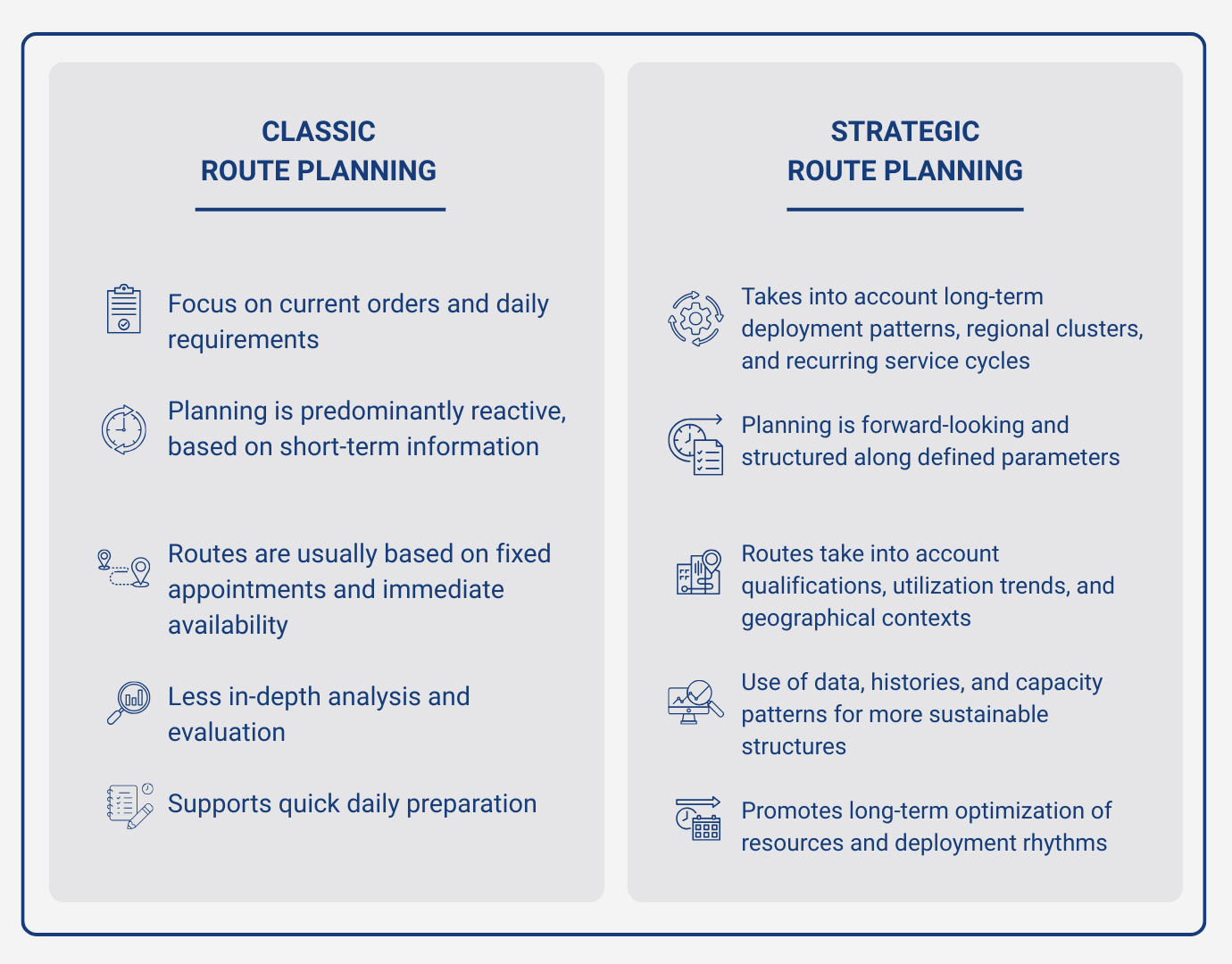
Different planning approaches have a significant impact on efficiency, stability, and work rhythms in the field. While classic methods primarily reflect the immediate daily routine, strategic planning is more focused on recurring patterns and future requirements. This comparison shows how both approaches work and what effect they have in the service environment:
| Classic Route Planning | Strategic Route Planning |
| Focus on current jobs and day-to-day operational requirements | Considers long-term deployment patterns, regional clusters, and recurring service cycles |
| Planning is largely reactive and based on short-term information | Planning is proactive and structured around defined framework conditions |
| Routes are usually aligned with fixed appointments and immediate availability | Routes take qualifications, utilization trends, and geographic relationships into account |
| Lower depth of analysis and evaluation | Uses data, historical records, and capacity patterns to build more sustainable structures |
| Supports fast day-to-day preparation | Promotes long-term optimization of resources and deployment cycles |
Strategic route planning creates a foundation in the field that makes the entire service process more stable and predictable. With a broader view of data, capacities, and regional characteristics, teams benefit from better-structured tours and a significantly more relaxed workflow.
Plan service calls successfully – prepare routes sensibly
A structured approach to resource planning forms the basis for smooth day-to-day service operations. Route planning in the field allows service calls to be organized in a traceable manner, enabling teams to better control their work rhythm. Well-prepared processes reduce ambiguities and increase quality on site. Professional planning provides orientation and makes it easier to respond appropriately to changing requirements.
Plan routes efficiently – strengthen service quality in a strategic way
See how Innosoft supports you with transparent deployment management.
Learn more now and secure your consultation.
More efficient service processes: Advantages of digital route planning
Digital solutions help field service teams prepare daily routes in a structured manner and carry out assignments reliably. Route planning in field service helps to make processes clearer, which benefits both service quality and efficiency. The following advantages show how digital planning techniques can significantly improve everyday service operations.
Route planning in field service: making the most of your potential
Planning in field service benefits greatly from clear decision-making processes and good preparation of daily routines. Every tour requires a structure that is based on realistic conditions and makes sensible use of both time and resources. Strategic optimization measures can significantly stabilize everyday work and noticeably increase the level of service:
Practical tips for route planning in field service
Well-thought-out preparation helps field service teams to carry out their rounds reliably and without unnecessary interruptions. Structured route planning in field service allows assignments to be organized in a way that benefits both service quality and efficiency. Practical tips make it easier to maintain an overview and confidently handle the daily demands of field service. The following tips show which aspects offer particularly helpful guidance.
Careful preparation begins with complete details of the address, contact person, and assignment details. Precise information enables a realistic assessment of the day’s schedule and prevents unnecessary queries or detours. The better this basis is maintained, the more stable the subsequent tour will be.
A geographically sensible grouping of locations reduces long distances and relieves the team during the course of the day. This grouping results in clear routes that can be worked through without unnecessary detours. At the same time, a natural rhythm is created that promotes the flow of work.
Time intervals between appointments provide leeway for unforeseen delays. Such buffers give technicians the opportunity to respond flexibly to longer assignments without jeopardizing the entire route. This reduces pressure in day-to-day business and improves the quality of work.
Current traffic conditions, inner-city restrictions, or seasonal influences have a direct impact on the duration of individual journeys. Taking these factors into account in advance allows for more realistic route planning and reduces waiting times on the roads. At the same time, it provides a better overview of alternative routes should adjustments be necessary.
Well-maintained master data forms an essential basis for any professional planning. Updated addresses, correct contact details, and complete information from previous assignments noticeably improve the quality of route preparation. A reliable database not only facilitates routing, but also communication throughout the entire service process.
Structured tours for a smooth daily service routine
Learn how Innosoft improves planning, transparency, and resource utilization. Get a no-obligation consultation now.
Field service organization – the potential of integrated planning software
A professional solution should support routes in such a way that planning, adjustment, and execution are reliably interlinked. With the introduction of FSM software such as Innosoft, a structure can be established in which relevant planning information is clearly available and workflows for dispatchers and technicians remain easy to follow. The following criteria show which aspects are particularly relevant when making a selection and what contribution Innosoft makes in a service context:

Field service organization – how modern planning solutions strengthen processes
Final considerations show how strongly structured planning influences everyday work in service. Route planning in field service helps teams to organize assignments in a comprehensible manner, use routes efficiently, and make the daily routine calmer. Well-coordinated processes help to reduce stress and improve the quality of preparation. Digital support such as the solutions from Innosoft offers transparent planning data, precise control options, and clear structures that raise the entire process to a higher level. Those who use these options increase efficiency, improve service quality, and strengthen cooperation between dispatch and field service.
FAQs about route planning in the field
Field service route planning describes the structured organization of routes, appointments, and sequences in the service field. The aim is to reduce travel times, stabilize processes, and optimize the deployment of technicians throughout the day. This is based on precise address data, time specifications, and up-to-date information from dispatch and the field.
Essentially, a distinction is made between classic and strategic route planning. Classic methods are based on short-term requirements and daily orders, while strategic approaches take into account long-term patterns, regional clusters, service intervals, and capacity trends. Both variants have different effects on efficiency, planning reliability, and resource utilization.
A route plan is based on complete assignment information, geographical grouping, and suitable time slots. Those who use digital tools benefit from map views, real-time data, and dynamic adjustment options. The better the data quality and preparation, the smoother the field service tours will run.
Free solutions usually offer basic routing functions, but without the advanced features required for professional service operations. They are primarily suitable for simple routes with few requirements. For complex processes, multiple technicians, or extensive service calls, specialized FSM software such as Innosoft with integrated planning logic is generally recommended.